
RegulationPublished · Updated · 18 min read
We read the full EU Digital Product Passport regulation so you don't have to
The EU digital product passport regulation decoded for fashion brands. ESPR timelines, DPP data requirements, and what to prioritise before delegated acts land.
Written by Vincent Ghilione, Founder, Wetrack
Regulation (EU) 2024/1781 is now law. Here is what European fashion brands actually need to understand, and what they can stop worrying about until the delegated acts arrive.
Table of Contents
- The Document Nobody Reads but Everyone References
- What the ESPR Actually Is (and What It Is Not)
- Two Types of Requirements: Performance and Information
- The EU Digital Product Passport Regulation: What It Actually Specifies
- The Destruction of Unsold Goods: The Deadline That Is Already Here
- Who Does This Apply To? The Geographic Scope Question
- The Interoperability Principle: Why It Matters More Than Most Brands Realise
- The Delegated Act Timeline: Where Things Actually Stand
- What the Regulation Says About SMEs
- What Fashion Brands Should Be Doing Right Now
- FAQ
- Conclusion
- Sources
The Document Nobody Reads but Everyone References
The EU digital product passport regulation is one of the most consequential pieces of sustainability legislation for fashion brands this decade, yet almost nobody in the industry has actually read it. It runs to several hundred pages. It is written in the precise, layered language of EU legislative drafting. It references other regulations, amends earlier directives, and uses the word “delegated acts” approximately two hundred times. Regulation (EU) 2024/1781, better known as the Ecodesign for Sustainable Products Regulation, or ESPR, is the foundational law behind the Digital Product Passport (DPP).
Most brands are working from summaries, conference slides, or consultancy decks. Which is understandable. But it also means that a lot of the conversation around the DPP is either alarmist, oversimplified, or missing the nuances that actually matter for how you plan your next two to three years.
So here is what the regulation actually says, decoded for fashion brand owners, founders, product teams, and sustainability leads who need to make real decisions, not just prepare for future conversations. If you are looking for a broader overview first, our regulation guide for fashion is a good starting point.
What the ESPR Actually Is (and What It Is Not)
The Ecodesign for Sustainable Products Regulation entered into force on 18 July 2024, replacing the older Ecodesign Directive (2009/125/EC) that had applied mainly to energy-related products. Its scope is dramatically wider: it now covers virtually all physical goods placed on the EU market, with specific exemptions for food, medicines, vehicles with existing frameworks, and living organisms.
The ESPR is a framework regulation. This is the single most important thing to understand.
It does not, on its own, tell you what data to put in your Digital Product Passport. It does not tell you exactly how durable your jacket must be, or what percentage of recycled content you need in your knitwear. What it does is establish the architecture, the legal authority, the principles, the governance mechanisms, through which the European Commission can issue product-specific rules called delegated acts.
Think of the ESPR as the constitution. The delegated acts are the specific laws that flow from it. For fashion brands, this means that the regulation is in force, but many of its most operational requirements for textiles are still being written.
That distinction matters enormously for how you plan.
Two Types of Requirements: Performance and Information
The ESPR builds its compliance framework around two kinds of requirements, and it is worth understanding both clearly because they operate very differently.
Performance Requirements
Performance requirements define how a product must perform, or not perform, across a set of environmental dimensions. These are binding, minimum thresholds. For fashion, the areas that delegated acts are expected to address include:
- Durability: minimum standards for fabric tensile strength, seam slippage, and colour fastness after washing. The regulation’s stated goal is to end premature obsolescence, the design of products that fail or wear out earlier than necessary.
- Recyclability: products must be designed to support high-purity sorting. In practice this has significant implications for blended fabrics like poly-cotton, which are notoriously difficult to separate and recycle.
- Recycled content: brands may face mandatory minimum thresholds for recycled material use, with expert consensus suggesting the Commission will require textile-to-textile recycled content, not simply rPET from plastic bottles.
- Hazardous substances: under Article 7(5) of the ESPR, the presence of Substances of Concern (SoC) throughout the product lifecycle must be tracked and disclosed.
None of these requirements are operational yet for textiles. They will be set out in the delegated act for apparel, which is currently expected to be adopted in late 2026 or early 2027, with compliance required approximately 18 months after adoption, placing the practical deadline around mid-2028 for most brands.
Information Requirements
Information requirements define what data must be made available, to whom, and how. This is where the Digital Product Passport lives.
The DPP is the instrument through which information requirements are delivered. It is designed to be a digital, machine-readable record that travels with the product across its entire lifecycle, accessible to consumers, repairers, recyclers, customs authorities, and market surveillance bodies.
The regulation is explicit that the DPP should not be just a static label. It is designed to be dynamic, updatable, and linked to a unique product identifier at the item, batch, or model level, depending on what the delegated act determines is appropriate for that product group.
The EU Digital Product Passport Regulation: What It Actually Specifies
This is the section most brands need to read carefully, because the gap between what the ESPR defines at the framework level and what brands are often told they need to do is significant.
What the ESPR establishes now
The regulation defines the essential architecture of the DPP system:
Unique product identifiers: every product covered by a DPP must carry a unique identifier, at item, batch, or model level, issued in accordance with internationally recognised standards. The regulation explicitly requires that data be transferable “through an open interoperable data exchange network without vendor lock-in.” This is not an accident. The EU has deliberately designed the system so that brands cannot be trapped by a single platform or service provider.
Data carriers: the DPP must be accessible via a physical data carrier, a QR code or similar, ideally placed on the product itself to ensure accessibility throughout its lifecycle. The regulation acknowledges that exceptions may apply depending on product size and nature.
Decentralised storage: unlike some early expectations, the DPP is not a centralised EU database that brands upload into. It is a decentralised system, managed by economic operators, meaning you as the brand or manufacturer, with a public registry recording unique identifiers for enforcement purposes. The DPP registry itself was required to be operational by 19 July 2026.
Third-party backup: economic operators are required to maintain a backup copy of the DPP data through an independent third-party service provider. This ensures data remains accessible even if the brand undergoes insolvency or ceases EU operations.
Differentiated access: not all DPP data is public. The regulation explicitly requires that data access be tiered based on data type and stakeholder category. Consumers may see composition and care information. Customs authorities may see supply chain identifiers. Recyclers may need chemical composition data. The architecture must support all of these access levels.
Backup for after insolvency: the regulation specifically requires that DPP data remain accessible even in cases of company insolvency, liquidation, or cessation of EU activity. This has implications for how brands choose their DPP infrastructure providers.
What the ESPR does not yet specify for textiles
The precise data fields that a textile or apparel DPP must contain will be defined in the delegated act. Until that act is adopted, the ESPR gives us categories and principles, not exact requirements.
Based on the framework and on the European Parliamentary Research Service (EPRS) study published in June 2024, which specifically addressed DPP recommendations for textiles, the following data categories are widely expected to appear:
- Product composition (material types and percentages, including recycled content)
- Substance of concern tracking
- Supply chain traceability (key manufacturing stages, locations of weaving, dyeing, finishing)
- Durability and care information
- Recyclability and end-of-life guidance
- Carbon footprint and environmental indicators
- Repair and maintenance instructions
- Certifications and compliance documentation
These are not confirmed requirements yet. But they represent the current state of expert and institutional thinking, and they are worth using as a planning framework now.
The Destruction of Unsold Goods: The Deadline That Is Already Here
While the textile DPP delegated act is still in development, there is one ESPR requirement for fashion brands that is already live, and much less discussed.
Article 25 of the ESPR prohibits the destruction of unsold consumer products. For large enterprises selling textiles and footwear, this ban entered into force on 19 July 2026. For medium-sized enterprises, it applies from 19 July 2030. Micro and small enterprises are currently exempt.
This is not a distant planning concern. It is active law for any large fashion company operating in the EU market right now.
The regulation also requires, under Article 24, that companies subject to this provision publish annual disclosure reports covering their handling of unsold goods, with the first reporting period covering the 2025 financial year.
If your brand is classified as a large enterprise (generally: more than 250 employees or over €50 million in annual turnover), you need to have a clear position on this today. Not in 2027 when the DPP delegated act lands. Now.
Who Does This Apply To? The Geographic Scope Question
One of the most common misunderstandings about the ESPR concerns who it applies to. The regulation is unambiguous: it applies to any physical product placed on the EU market, regardless of where the producing brand is based.
A brand headquartered in New York, Tokyo, or São Paulo that sells clothing through a European subsidiary or directly to EU consumers via e-commerce is within scope. “Placing on the market” means the first time a product is made available on the EU market for sale, distribution, or use, and this applies equally to imports and domestically produced goods.
“Made in Europe” is not a compliance shortcut. Geography of origin does not determine the scope of ESPR obligations. What determines scope is whether the product is placed on the EU market.
For fashion brands in Switzerland, which, as an EEA-adjacent market, is watching these developments closely, the practical implication is that any brand exporting to or operating in EU markets must plan for ESPR compliance regardless of Swiss domestic regulation.
The Interoperability Principle: Why It Matters More Than Most Brands Realise
The ESPR contains a detail that deserves much more attention from brands than it typically receives: the explicit requirement for interoperability and data portability.
The regulation states that data in the DPP must be transferable “through an open interoperable data exchange network without vendor lock-in.” Service providers that store or manage DPP data will need to be certified or meet specific technical requirements. The Commission has the authority to develop a certification scheme for DPP service providers.
This matters for brands for a very practical reason: the DPP provider you choose today is not necessarily the one you will use in five years. The regulation is designed so that your product data is not trapped in a proprietary system. It should be possible to migrate, export, and share your data across platforms.
I think this is one of the most commercially significant aspects of the ESPR that brands are underweighting right now. The companies choosing DPP infrastructure in 2025 and 2026 are making architectural decisions that will affect their operational flexibility for a decade. Choosing a closed, proprietary system because it is convenient today is a strategic error, even if it is technically compliant.
The principle of portability should be a decision criterion in any vendor evaluation. Our DPP platform evaluation checklist covers this in detail. Ask explicitly: can I export my entire DPP dataset in a standard format? Can another provider read it? Is the data structure based on open standards like GS1 Digital Link?
The Delegated Act Timeline: Where Things Actually Stand
Given that so much depends on the delegated acts, here is an honest picture of where the textile delegated act process currently stands, based on the most recent publicly available information.
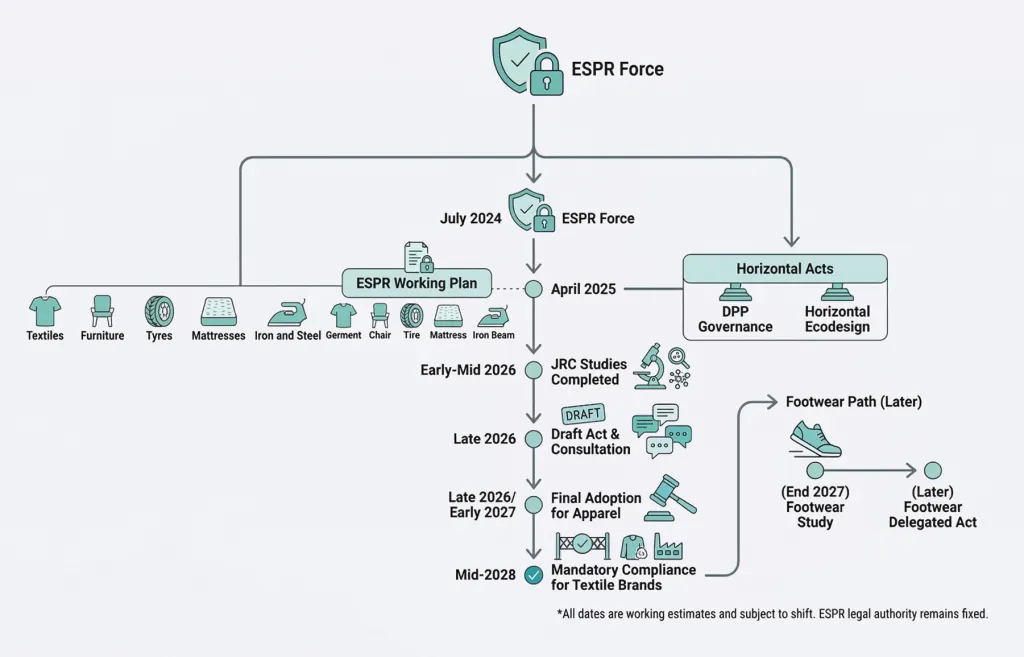
July 2024: ESPR entered into force.
April 2025: The European Commission adopted the ESPR 2025,2030 Working Plan. Textiles and apparel were confirmed as priority product categories, along with furniture, tyres, mattresses, iron and steel, and aluminium. The Working Plan formally launched the process of developing the delegated act for textiles.
April 2025: The Commission also adopted two horizontal acts, one establishing general governance rules for DPP service providers and registries, and one covering horizontal ecodesign requirements that apply across multiple product groups. These provide additional framework infrastructure.
Early to mid-2026: The Joint Research Centre (JRC) is expected to complete the preparatory technical studies for the textile delegated act. These studies form the evidentiary basis for the specific requirements.
Late 2026: Publication of the draft delegated act for apparel is expected, followed by stakeholder consultation.
Late 2026 / early 2027: Adoption of the final delegated act for apparel.
Around the first half of 2029 at the earliest (at least 18 months post-adoption, corrected 18 August 2026): Mandatory compliance for textile brands.
These dates should be treated as working estimates, not hard commitments. For a more detailed breakdown, see our DPP compliance deadline timeline. EU legislative timelines shift. What is not shifting is the direction of travel or the legal authority established by the ESPR itself.
Footwear is being treated as a separate product category. A study to evaluate footwear-specific requirements is expected to conclude by end 2027, meaning the footwear delegated act will likely come later than the apparel one.
What the Regulation Says About SMEs
The ESPR acknowledges the burden that compliance places on smaller businesses and includes several SME-specific provisions. These are worth knowing, even if they do not eliminate the compliance obligation.
The regulation requires that delegated acts explicitly assess the costs and benefits of DPP requirements at item, batch, or model level, and that these assessments specifically consider whether reliance on certain technical standards (some of which are not free of charge) creates disproportionate costs for micro, small, and medium-sized enterprises.
The destruction-of-unsold-goods ban already applies differentiated timelines: large enterprises from July 2026, medium from July 2030, and micro and small enterprises are currently exempt from that specific provision.
However, I want to be direct about this: SME status is not a pass. The textile DPP requirement, when it takes effect, is expected to apply across the board, with potential accommodations for implementation complexity, not for whether you have to comply at all. The SME provisions in the ESPR are about proportionality and transition support, not exemption.
If you are a small fashion brand selling in the EU, start building your data infrastructure now. The cost of doing it early and incrementally is a fraction of the cost of doing it under compliance pressure in 2027 or 2028.
What Fashion Brands Should Be Doing Right Now
The delegated act is still being written. That is not a reason to wait. Here is a practical framework for what to prioritise in the next 12 to 24 months.
1. Get your product data house in order
Before you can build a DPP, you need to know what is in your products. This sounds obvious. It is not easy. Most fashion brands do not have clean, structured, SKU-level data on material composition, supplier locations, or chemical inputs. Start the audit now, while there is still time to build systems calmly rather than reactively.
Work with your suppliers to understand what data they can actually provide. Our guide on mapping your supply chain for DPP compliance walks through this step by step. Identify the gaps. Begin filling them in order of importance, composition and supplier origin first, then deeper traceability layers.
2. Understand your obligations under the destruction ban
If you are a large enterprise, this is not future planning, it is current compliance. Audit your unsold inventory policies, your returns processing, and your end-of-season handling. Establish clear documentation that demonstrates compliance. Talk to your legal team about what “destruction” means in the context of Article 25 and what alternatives (donation, repair, resale, recycling) your operation supports.
3. Evaluate DPP infrastructure with the right criteria
If you are starting to evaluate DPP software or platform options, do not evaluate them purely on current feature sets. Evaluate them on:
- Open data standards and interoperability (can your data leave the platform?)
- Alignment with GS1 Digital Link and internationally recognised identifier standards
- Technical readiness for the expected data fields in the textile delegated act
- Ability to support differentiated access control (public, professional, regulatory)
- Long-term business stability of the provider
4. Engage with the delegated act consultation process
The European Commission runs stakeholder consultation processes before adopting delegated acts. These are not just formalities. Industry associations, brand coalitions, and individual companies have genuine opportunities to input on data requirements, transition timelines, and implementation details. If your interests as a small or mid-sized brand are not represented in these consultations, the delegated act will reflect the priorities of larger players who did show up.
Find your relevant industry association and understand whether they are participating in the ESPR textile working group process.
5. Start with what you can verify
We do not need perfect data on day one. The regulation itself anticipates a phased approach, and the EPRS study explicitly recommended a phased roll-out for textiles, starting with essential composition and supply chain data before adding deeper environmental indicators.
Start with what you can actually verify and document. Our guide on how to create a digital product passport covers this incremental approach. A clean, accurate, limited DPP is more valuable, and more credible, than a comprehensive DPP with data you cannot stand behind.
FAQ
Is the Digital Product Passport already mandatory for fashion brands?
Not yet for the DPP itself. The ESPR framework entered into force in July 2024, but the specific requirements for textiles and apparel, including mandatory DPP data fields, will be set in a delegated act expected to be adopted in late 2026 or early 2027. Compliance is then expected approximately 18 months later, around mid-2028. However, the ban on destruction of unsold textiles is already in force for large enterprises from July 2026.
Does the ESPR apply to my brand if we are not based in the EU?
Yes. The ESPR applies to any product placed on the EU market, regardless of where the brand is headquartered. If you sell to EU consumers, through your own channels, through distributors, or through retailers, you are within scope. This includes brands based in Switzerland, the UK, the US, and elsewhere.
What data will the textile DPP need to contain?
The precise data fields will be defined in the textile delegated act, expected in 2027. Based on the ESPR framework and EPRS recommendations, likely required categories include: material composition and recycled content, Substances of Concern tracking, supply chain traceability (weaving, dyeing, finishing stages), durability and care information, recyclability and end-of-life guidance, and relevant certifications.
Can I use any DPP software provider I want?
You have flexibility in choosing your provider, but the regulation requires that DPP data be stored in a way that supports access continuity, including after insolvency, and that data be portable across an open interoperable network. Providers will eventually need to meet certification requirements being developed by the Commission. Choose a provider aligned with open standards like GS1 Digital Link.
What is the difference between item-level, batch-level, and model-level DPP?
Model level means one DPP covers all units of a product that share the same design and technical specifications. Batch level means one DPP per production run. Item level means one DPP per individual physical unit. The delegated act for textiles will specify which level is required, likely influenced by factors such as supply chain complexity and the practicality of item-level tracking at fashion scale.
Are small fashion brands exempt from the DPP requirement?
The ESPR includes SME-specific provisions aimed at reducing disproportionate burdens, and certain specific measures (like the destruction ban) have differentiated timelines for smaller businesses. However, the DPP requirement itself is not expected to include a general SME exemption. Accommodations may apply to implementation complexity or timelines, but the underlying obligation is expected to apply broadly.
What does “Substances of Concern” mean under the ESPR?
Substances of Concern (SoC) refers to chemicals identified as potentially hazardous to human health or the environment, including substances already regulated under REACH (Regulation EC No 1907/2006) and others identified through the ESPR process. Brands will need to track the presence of these substances throughout the product lifecycle and disclose them in the DPP. This is one of the most operationally challenging requirements for fashion, given the complexity of dyeing and finishing chemistry in global supply chains.
Do products already on the market before the DPP enters into force need to be retroactively equipped with a DPP?
Generally, no. Products placed on the EU market before the DPP enforcement date for textiles takes effect are expected to be exempt from the DPP requirement. New production and imports introduced after the effective date must comply. This is an important planning consideration for brands managing product development cycles: items entering production in late 2027 may need to carry a DPP by the time they reach the market.
Conclusion
The ESPR is real. The DPP is coming. But the picture is more structured and more manageable than the noise around it often suggests.
The regulation that is actually in force today establishes a framework, not a complete operational specification. The delegated act that will determine exactly what your textile DPP must contain is still being written, with adoption expected in late 2026 or early 2027 and compliance around mid-2028. That is meaningful lead time if you use it well.
What is not in the future is the destruction ban. Large enterprises needed to stop destroying unsold textiles as of July 2026. If that applies to you, it is a current obligation, not a planning item.
What I keep coming back to, after going through the EU digital product passport regulation carefully, is that the foundational work brands need to do, mapping product data, structuring supplier relationships, auditing material composition, is valuable regardless of regulation. The brands that will handle the DPP requirement most smoothly are the ones that have already built operational discipline around their product data. Combined with tightening anti-greenwashing regulation, the ESPR is accelerating something that was already necessary.
Start now, with what you have. Improve over time. That is both the practical approach and, honestly, what the regulation’s own architects anticipated.
Sources
- Regulation (EU) 2024/1781 of the European Parliament and of the Council of 13 June 2024 (ESPR), EUR-Lex: https://eur-lex.europa.eu/eli/reg/2024/1781/oj/eng
- European Commission ESPR 2025,2030 Working Plan (April 2025), European Commission: https://ec.europa.eu/growth/industry/sustainability/ecodesign-sustainable-products-regulation_en
- European Parliamentary Research Service (EPRS), Digital Product Passport for Textiles study (June 2024)
- EU Strategy for Sustainable and Circular Textiles (March 2022), European Commission
- GS1 Standards Enabling the EU Digital Product Passport, GS1 Europe: https://gs1.eu/wp-content/uploads/2024/12/GS1-Standards-Enabling-DPP.pdf
- CIRPASS Project (EU Horizon-funded DPP pilot programme, 2024,2027), https://cirpassproject.eu
- White & Case: Eight key aspects to know about the ESPR, https://www.whitecase.com/insight-alert/eight-key-aspects-know-about-eu-ecodesign-sustainable-products-regulation
- Regulation (EC) No 1907/2006 (REACH), EUR-Lex, on Substances of Concern definitions
Next step
See what a passport would already contain for one of your products.
Free, one product, from your public data. You get a dated report and a sample passport you can open.
Vincent builds Wetrack and its sister product Weloop from Carouge, Switzerland. 25 years of building digital products for brands, now spent on product data, passports and what the ESPR actually asks of a fashion brand.
LinkedIn (opens in a new tab)Reviewed for accuracy by the Wetrack team. Regulatory dates come from official EU sources and are re-checked when the rules move; the date at the top of this page tells you when. This guide is information, not legal advice.