


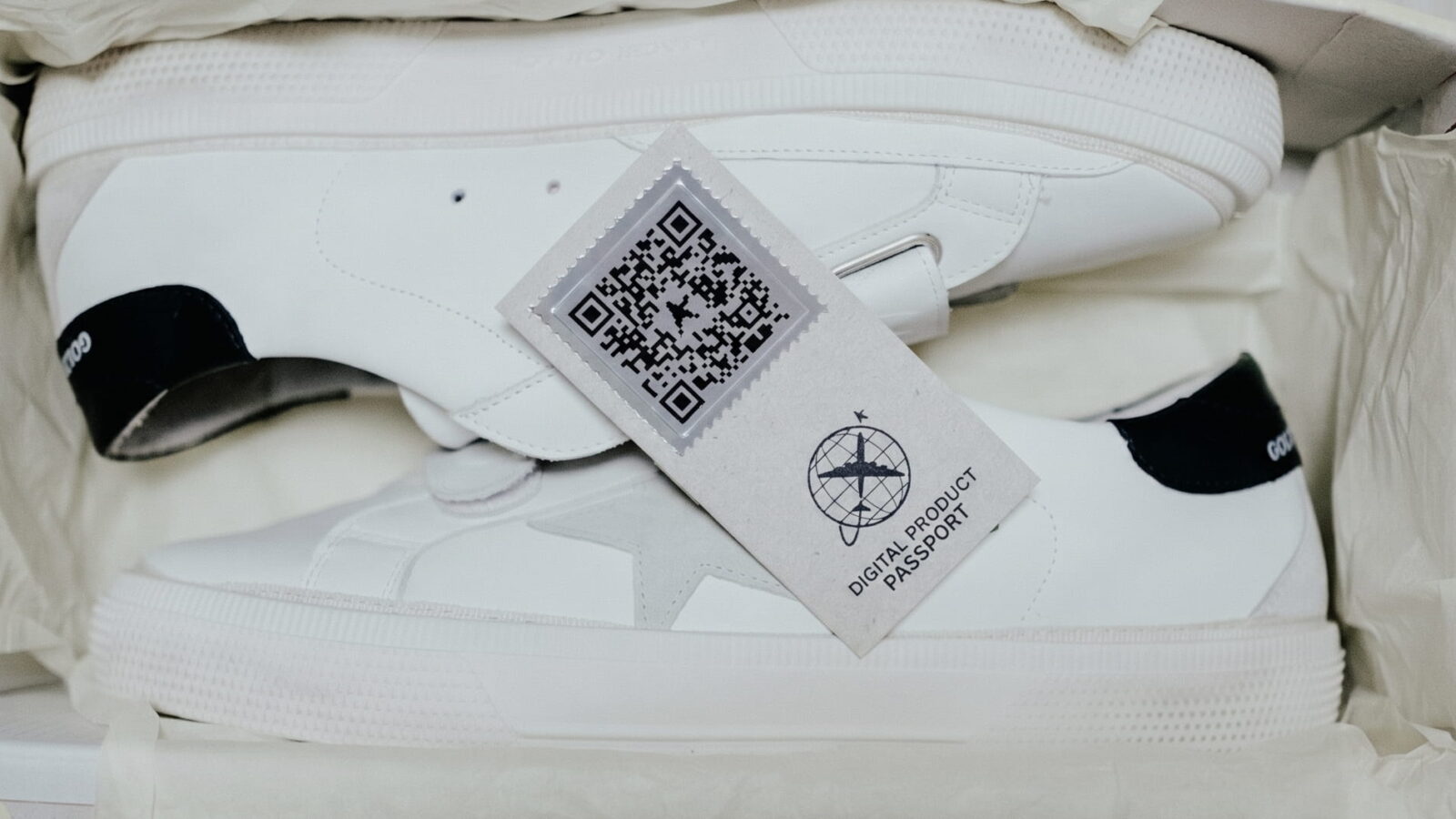
Your Digital Product Passport needs a physical link, something on the garment that connects the physical product to its digital data. That link is called a data carrier, and for fashion brands, the choice comes down to three technologies: QR codes, NFC chips, and RFID tags.
The decision matters more than most brand owners realise. The data carrier you choose affects your per-unit cost, how consumers interact with the passport, whether your products work with retail POS systems, and how the garment behaves in resale, recycling, and sorting facilities downstream.
This article compares the three options honestly, what each does well, where each falls short, and which one makes sense for different types of fashion brands. We also cover how the choice connects to GS1 Digital Link standards and what the ESPR actually says about data carriers.
Table of Contents
What the regulation says (and doesn’t say)
The ESPR defines a data carrier as “a linear barcode symbol, a two-dimensional symbol or other automatic identification data capture medium that can be read by a device.” That’s deliberately broad. The regulation does not mandate a specific technology. Brands can choose QR codes, NFC, RFID, or any combination.
What the regulation does require is that the data carrier is physically attached to the product (not just on the hang tag, which gets removed), is scannable without a dedicated app (a standard smartphone camera must work), links to a unique product identifier registered in the EU DPP registry (operational from July 2026), and remains functional throughout the product’s useful life, including through resale and recycling.
That last point is critical for fashion. A QR code printed on a care label that fades after 50 washes fails the “useful life” requirement. An NFC chip sewn into a seam that survives years of wear meets it. The technology choice has durability implications that most comparison articles overlook.
QR codes: the practical default
For most fashion brands, especially small and mid-sized ones, QR codes are the right starting point. Here’s why.
Cost. A QR code is essentially free. It’s a printed pattern, ink on a label. Whether you print it on a woven care label, a heat-transfer label, or a hang tag (not recommended as the sole carrier), the marginal cost per unit is near zero. For a brand producing 500 to 50,000 units per season, this matters.
Universality. Every smartphone made in the last five years can scan a QR code natively, no app required. The consumer points their camera at the code, taps the link, and sees the passport. There’s no technology barrier. Adoption studies consistently show QR codes as the most frictionless consumer interface for product information.
GS1 Digital Link compatibility. When you encode a GS1 Digital Link URL into a QR code, the same code serves two functions: consumers scan it and reach the passport page, while retail POS scanners extract the GTIN for checkout. One symbol, two purposes. This is why the global retail industry is migrating to QR-based 2D barcodes under the “Sunrise 2027” initiative.
Limitations. QR codes require line-of-sight, someone has to physically see and scan the code. They can’t be read through packaging or at a distance. They can be cloned (someone could photograph your QR code and reproduce it). And they depend on print quality, a poorly printed or faded QR code becomes unreadable.
Durability solution. Print the QR code on a woven label, not a paper label. Woven labels survive hundreds of wash cycles. Laser-engraved QR codes on leather goods or metal hardware are even more durable. The key is to treat the QR code as a permanent product feature, not an afterthought printed on packaging material.
NFC: the premium experience
NFC (Near Field Communication) is a short-range wireless technology, the same technology that powers contactless payments. An NFC chip is a tiny antenna and memory unit, typically embedded in a woven label, a button, or a small tag sewn into the garment.
Consumer experience. Instead of scanning a camera, the consumer taps their phone against the label. The passport opens instantly. There’s no need to align a camera, no issues with poor lighting or wrinkled labels, and no QR code aesthetic to accommodate in your label design. For luxury and premium brands, this creates a cleaner, more seamless interaction.
Authentication. NFC chips can carry cryptographic signatures that are extremely difficult to clone. Unlike a QR code (which is just a printed URL that anyone can copy), an NFC chip provides hardware-level authentication. When a consumer taps a garment with a genuine NFC chip, they can be confident it’s authentic. This is why luxury brands like LVMH’s Aura Blockchain Consortium and individual houses are investing in NFC-based digital IDs.
Cost. An NFC chip costs roughly €0.15–€0.50 per unit at scale, depending on form factor and memory capacity. For a €200 jacket, that’s negligible. For a €15 t-shirt, it’s a meaningful percentage increase in trim cost. NFC makes economic sense for products above roughly €50–€80 retail.
Compatibility. All modern iPhones (from iPhone 7 onward) and most Android phones support NFC reading without an app. However, consumer awareness of NFC is lower than QR code awareness. Many shoppers don’t know they can tap their phone against a tag. This awareness gap is closing but hasn’t closed yet.
Limitations. NFC requires very close proximity (typically 1–4 cm). It can’t be read at a distance or through packaging. It requires the chip to be physically embedded in the garment, which adds a step to the manufacturing process. And NFC chips, while small, add bulk to labels, which matters for lightweight garments and underwear.
RFID: the supply chain workhorse
UHF RFID (Ultra-High Frequency Radio-Frequency Identification) is a different beast from NFC. While NFC is designed for one-to-one, close-range interaction, UHF RFID is designed for bulk scanning at a distance, reading hundreds of items simultaneously without line-of-sight.
Supply chain applications. RFID is already used at scale in fashion for inventory management, warehouse operations, and anti-theft. If your brand sells through major retailers, your products may already carry RFID tags for retail operations. Companies like Inditex (Zara) have deployed RFID across their entire supply chain for years.
DPP potential. An RFID tag that’s already on the garment for inventory purposes could theoretically double as a DPP data carrier. The tag carries a unique identifier that can link to the passport database. At end-of-life, sorting and recycling facilities could use RFID readers to identify composition and processing instructions at high speed, scanning entire bales of garments rather than inspecting them one by one.
Cost. UHF RFID tags cost roughly €0.05–€0.15 per unit at scale. Washable, textile-embedded RFID tags (designed to survive the garment’s lifecycle, not just the retail floor) cost more, €0.20–€0.50. The tags themselves are affordable; the infrastructure (readers, software integration) is the larger investment.
Limitations for consumer-facing DPP. UHF RFID tags cannot be read by standard smartphones. They require dedicated RFID readers. This means RFID alone doesn’t meet the ESPR requirement that the data carrier be “easily accessible” to consumers via a smartphone. For the consumer-facing side of the DPP, you still need a QR code or NFC chip. RFID solves the supply chain and end-of-life problem, not the consumer transparency problem.
The hybrid approach (and why it’s where fashion is heading)
The most mature DPP implementations don’t pick one technology, they layer them.
QR code + NFC is the most common pairing for consumer-facing brands. The QR code handles universal accessibility (anyone can scan it), while the NFC chip adds authentication for premium products and a smoother tap-to-read experience. Both can point to the same passport URL.
QR code + RFID is the pairing for brands that sell through retail partners or need supply chain automation. The QR code is the consumer access point. The RFID tag handles inventory, logistics, and future sorting/recycling operations. The same unique product identifier links both to the passport database.
NFC + RFID is emerging for luxury brands with high-value items where authentication and supply chain visibility are both critical. Some tags combine NFC and UHF RFID in a single chip (known as dual-frequency tags), reducing the number of physical components on the garment.
For most small and mid-sized fashion brands, the practical recommendation is straightforward: start with QR codes. They’re free, universal, and fully compliant. Add NFC if your price point and brand positioning justify it. Consider RFID only if your retail partners require it or if you’re preparing for automated end-of-life processing at scale.
Where to place the data carrier on a garment
Placement matters as much as technology choice. The data carrier must survive the garment’s useful life, including washing, wearing, and resale, so it needs to be on a permanent component.
Care label (recommended). The care label is the most common placement and the most practical. It stays with the garment for life, it’s expected by consumers, and it already carries regulated information (composition, care symbols, country of origin). Adding a QR code or NFC chip to the care label integrates the DPP into an existing element. Woven care labels with printed QR codes survive hundreds of washes.
Branded label/neck label. Some brands add the QR code to the main brand label. This works for visibility but can create aesthetic concerns. It also may be cut out by consumers who find it uncomfortable.
Sewn-in tag. A small, dedicated DPP tag sewn into a side seam or hem. This is where NFC chips are typically placed. It’s discreet and durable.
Hang tag (not sufficient as sole carrier). A hang tag is fine as an additional touchpoint, especially for the retail floor, where the first scan often happens. But it’s removed after purchase, so it can’t be the only data carrier. The regulation requires the passport to remain accessible throughout the product’s lifecycle.
The golden rule: if the customer can remove it, it’s not sufficient. Your QR code or NFC chip must be on something permanent.
How to choose: a decision framework
The right technology depends on your brand’s price point, volume, sales channels, and circular ambitions.
If you’re a small brand with products under €80, producing fewer than 50,000 units per year, selling primarily direct-to-consumer: QR code on the care label. This is fully compliant, cost-effective, and sufficient. Don’t over-engineer it.
If you’re a premium or luxury brand with products above €100, where authentication and brand experience matter: QR code + NFC. The QR code provides universal access. The NFC chip adds the premium tap-to-read experience and anti-counterfeiting protection.
If you sell through major retail partners who require RFID for inventory management: QR code + RFID. Your retail partners may already dictate this. The QR code handles the consumer-facing DPP. The RFID tag handles supply chain operations.
If you’re building circular services, branded resale, trade-in programmes, or partnerships with secondhand platforms: QR code minimum, NFC or RFID if economics support it. Circular services benefit from durable, authenticated identification that survives multiple ownership cycles.
What your DPP platform needs to support
When choosing a DPP platform, check that it generates QR codes compliant with GS1 Digital Link standards, not proprietary URLs that lock you into one provider. The platform should let you download QR code files in print-ready formats (SVG, PDF, EPS) at the resolutions your label supplier needs. If you’re using NFC, the platform should support encoding NFC tags with the same GS1 Digital Link URL. And the passport URL should resolve on any device without requiring an app installation.
See what a QR code-linked DPP looks like. Start building yours.
Frequently asked questions
Does the ESPR mandate QR codes specifically?
No. The ESPR allows any “automatic identification data capture medium” that can be read by a device. QR codes, NFC, RFID, and barcodes are all valid options. The regulation doesn’t prescribe a specific technology, it prescribes accessibility, durability, and linkage to a unique product identifier.
Can I use just a QR code on the hang tag?
As an additional touchpoint, yes. As your sole data carrier, no. The hang tag is removed after purchase, and the regulation requires the passport to remain accessible throughout the product’s lifecycle. Your primary QR code or NFC chip must be on a permanent component, typically the care label or a sewn-in tag.
How much does NFC add to the per-unit cost?
Roughly €0.15–€0.50 per unit at scale, depending on the chip type and form factor. For a €200 jacket, that’s 0.1–0.25% of the retail price. For a €15 t-shirt, it’s 1–3%. Most brands find NFC cost-effective above a €50–€80 retail price point.
Can a consumer scan an RFID tag with their phone?
Standard UHF RFID tags cannot be read by smartphones, they require dedicated RFID readers. NFC tags (which are a specific type of RFID operating at a different frequency) can be read by tapping a smartphone. This distinction is important: if your RFID tags are UHF (for supply chain use), they don’t serve as a consumer-facing DPP carrier. You still need a QR code or NFC chip for that purpose.
What if I already have RFID tags on my products for retail?
You can potentially link those existing RFID tags to your DPP database using the same unique product identifier. However, retail RFID tags are often designed to be removed at point of sale (anti-theft tags) or are not durable enough for the garment’s full lifecycle. Assess whether your existing tags survive washing and wear before relying on them as DPP carriers.
Should I wait for the delegated act to specify data carrier requirements before choosing?
No. The delegated act may specify minimum requirements (such as “must be readable without a dedicated app”), but it’s extremely unlikely to mandate one technology over another. QR codes already meet every foreseeable requirement. Start with QR codes now, and add NFC or RFID later if your business case supports it. Waiting means delaying your entire DPP implementation for a decision that has a clear default answer.
This guide reflects the data carrier landscape as of June 2026. The textile delegated act may specify additional technical requirements for data carriers. Stay informed.
This article has been reviewed for accuracy by the Wetrack team.
Some illustrations may be AI-generated in which case they are labeled. Report any issue.